An IPA illustration of Chongqing Chinese, my home dialect
For my phonetics course (LIGN 210) this quarter, I described the sound system of Chongqing Chinese (重庆话), the variety of Southwestern Mandarin I grew up speaking. About 32 million people speak it, but it is often filed under Sichuan Chinese or treated as close enough to Standard Mandarin to skip.
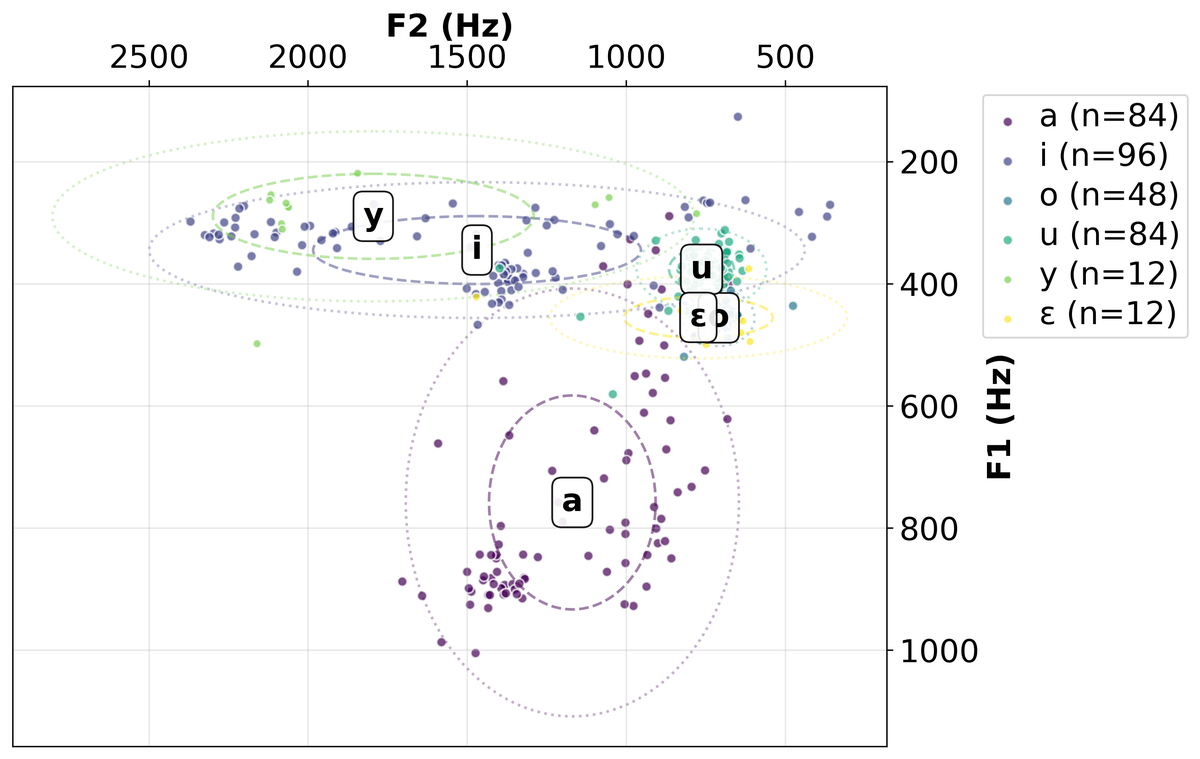
I recorded a native speaker producing minimal pairs for every consonant and vowel, plus the North Wind and the Sun passage, and measured the recordings in Praat. Some differences from Standard Mandarin:
- No retroflexes. 吃 ‘eat’ is [tsʰi³¹], with an alveolar affricate.
- No [n] at the start of a syllable. Words that begin with /n/ in Standard Mandarin begin with /l/, so 泥 ‘mud’ is [li³¹].
- [x] becomes [f] before [u]. 虎 ‘tiger’, [xu²¹⁴] in Standard Mandarin, is [fu²¹⁴].
- A voiced labiodental /v/, which Standard Mandarin lacks: 屋 ‘house’ is [vu³¹].
- Glottal stops between syllables, as in 木偶 ‘puppet’ /mu³¹ʔou⁴⁴/. Earlier descriptions do not mention these.
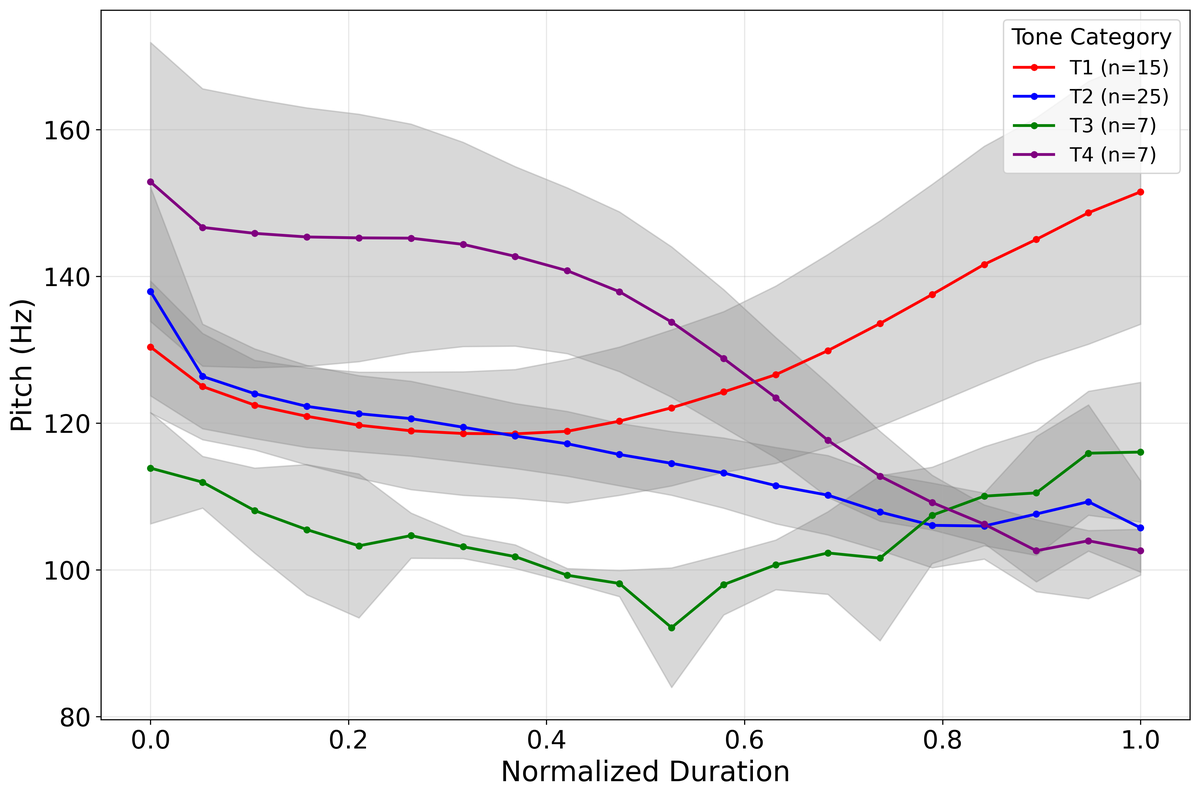
All four tones can be heard on a single syllable: 乌 [vu⁴⁵] ‘dark’, 屋 [vu³¹] ‘house’, 雾 [vu⁴¹] ‘fog’, and 舞 [vu²¹⁴] ‘dance’. In my recordings, the “high falling” tone (T3) dips below the “middle falling” one (T2), possibly because of creaky voice, which also makes automatic pitch tracking less reliable.
The data and scripts are on GitHub.