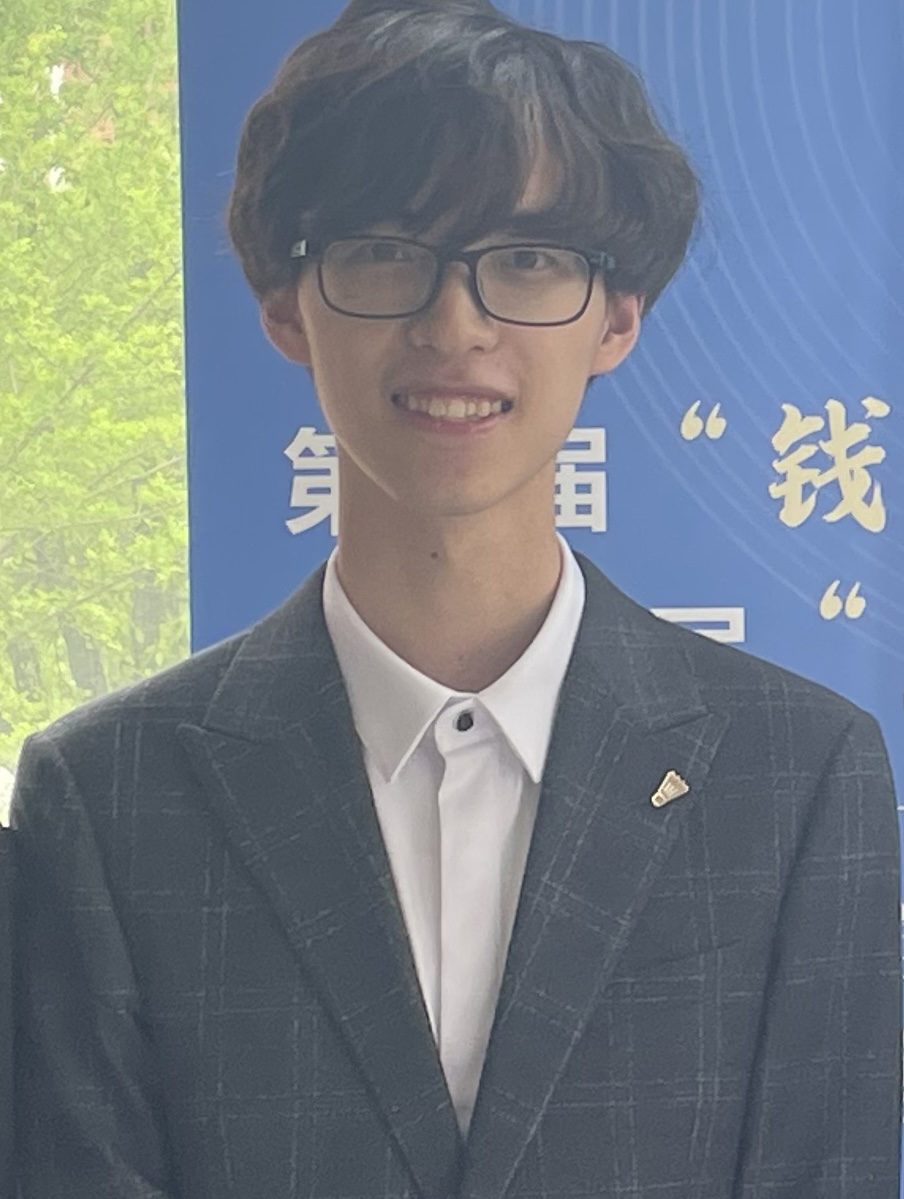
I am Hongao Zhu (IPA: /xʊŋ35 ɑʊ35/ /ʈʂu55/, Mandarin: 朱虹翱, pinyin: ZHŪ HÓNG ÁO).
I am a second-year PhD student in computational linguistics at UC San Diego, advised by Alex Warstadt in the Learning, Meaning, and Natural Language Lab (LeM🍋N Lab). Before UCSD, I received a B.A. in Linguistics from Shanghai Jiao Tong University.
I use language models to study how people learn and process language: whether models can show the critical-period effects seen in human second-language learners, when language model surprisal predicts human reading times across languages, and how to test what models know about grammar, as with the minimal-pair benchmark ZhoBLiMP. At SJTU, I worked with Hai Hu on how language models acquire the Ba construction, and since 2024 I have also worked with William Schuler at Ohio State on language model surprisal as a predictor of human reading times. I also co-organized the first ChineseBabyLM Challenge.
I’m looking for a research internship for summer 2027, especially on how people understand and interact with language models, on model evaluation, or on computational psycholinguistics. See the Contact page.
Curious what I have been thinking about lately? My Puzzles page covers questions such as whether language models can show a critical period, what makes a construction learnable, how to benchmark what vision-language models understand about sign language, when a voice model should take its turn, whether humans are LLMs, and how to detect AI impersonation.
To know more about me and my research, please visit the About page.
Posts
- Oct 19, 2026Paper accepted to EMNLP 2026
- Oct 4, 2026New preprint: does language model surprisal predict reading times in Mandarin Chinese?
- Sep 30, 2026captain-nemo: running large batches of GPU jobs on Nautilus
- Jul 12, 2026Findings of the first ChineseBabyLM Challenge
- May 4, 2026ZhoBLiMP is published in TACL
- Jan 10, 2026Wenzhi New Scholar Award (2026)
- Dec 6, 2025An IPA illustration of Chongqing Chinese, my home dialect
- Sep 1, 2025Starting my PhD at UC San Diego
- Nov 8, 2024ZhoBLiMP: a Systematic Assessment of Language Models with Linguistic Minimal Pairs in Chinese (2024)
- Aug 6, 2023Oxford Prospects Program (2023)
- Jun 1, 2023New Horizons in Digital Humanities & Cultural Data Science Workshop (2023)
- Apr 19, 2023Eternal themes and changing sentiments: An NLP-based diachronic study of classical literary works across 700 years (2021–2023)
- Apr 19, 2023Assessing the Communication Effect in Australian Public Discourse (2022–2023)
- Nov 18, 2022The 2022 China International Law of the Sea Moot Court Competition
- Jan 29, 2021Directly Admitted into Shanghai Jiao Tong University