ZhoBLiMP is published in TACL
The final version of ZhoBLiMP, the Chinese minimal-pair benchmark I helped build in Hai Hu’s lab at Shanghai Jiao Tong University, is now out in Transactions of the Association for Computational Linguistics (vol. 14, pp. 755–771). I first wrote about it when the preprint came out in November 2024.
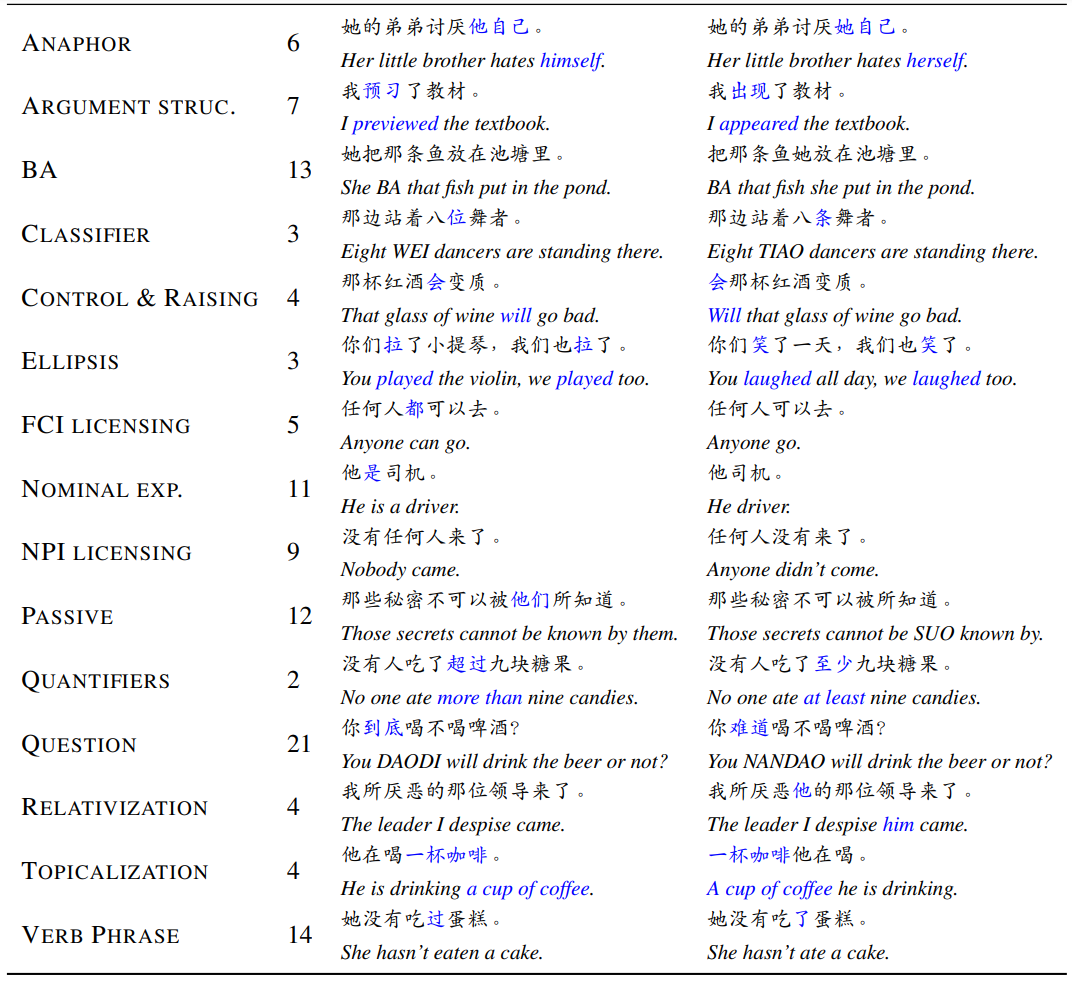
ZhoBLiMP has 118 paradigms covering 15 phenomena, from topicalization to the Ba construction, and comes with a suite of Chinese language models trained from scratch. The published version adds a new metric, sub-linear length normalized log-probabilities (SLLN-LP). The two sentences in a Chinese minimal pair often differ in length, which biases a direct comparison of their log-probabilities. SLLN-LP reduces this bias on ZhoBLiMP, as well as on the English BLiMP and the Japanese JBLiMP. Measured this way, anaphora, quantifiers, and ellipsis remain hard for models with up to 32B parameters.
Many thanks to my co-authors.